
The first article in this series examines what’s wrong with Finding Your Purpose, the second with the Problem of Progress through the presentation of diverse meta-models of progression. This article presents the operational implications of these distinctive models of progress.
Purpose
As a recap, most business problems eventually collapse into a deeper confusion about the relationship between purpose and progress. When an organization starts to scale, they implement optimization procedures that start to shape what counts as legible, what can be measured, and ultimately what’s actionable (think Seeing like a State by James C. Scott). As time goes on, these systems invert value creation. Rather than producing value, they start to consume value through the process of abstraction; they replace meaning with the representation of meaning.
Thanks for reading Axiaphore! Subscribe for free to receive new posts and support my work.
It gets worse with AI, what AI does is accelerate the routinization of these abstraction processes, and it does so explicitly through linguistic encoding. It’s a problem that currently AI’s domain is purely linguistic because it exacerbates three things: it reinforces that efficiency is a function of the reducibility of phenomena to their representation, it makes invisible what non-linguistic cognitive functions sustain an organization, and it buries the paucity of human labor that was once unaddressed and renders it completely addressable. Essentially, AI is a solid mimic of poor human labor. So now leaders are confronted with a new cost problem but also total lack of discernment and direction (that may have only existed weakly before, but is nigh impossible now).
In response, organizations often turn to abstract statements of purpose, but these either dissolve into vague moral language or simply restate existing products as ends in themselves; neither of which provides real criteria for what counts as progress. Focusing on intention doesn’t help, what’s missing is an understanding of what progress (and the good) can look like absent a purpose. What’s ultimately needed is a way for organizations to evaluate what type of teleological interpretive framework they inhabit, and whether they have the capability to carry meaning at all within this framework.
Progress
The second article described distinctive modes of progress - these are the implicit structures that shape the interpretive frameworks organizations inhabit.
If “finding your purpose” is largely unproductive in these contexts (and I believe it really is), the genuine strategic question becomes what kind of progress an organization intuitively enacts and what it believes it’s doing. The problem is that “Progress” itself has become an ideological shibboleth, it’s treated as a single universal, unilineal, trajectory rather than a polyvocal label of fundamentally distinct models, each with distinct assumptions about human nature, social change, and the role of institutions.
Externally imposed notions of progress, whether political, moral, or market-driven, are unsustainable in organizations that intend to have agency and identity (rather than being a mere function of a higher order system). They establish a dependency on external justification and eventually net out into compliance regimes rather than generative practices. This is why movements like ESG or DEI can’t sustain themselves as internal, motivating goods rather than externally subsidized requirements (to say nothing yet as to whether or not they are themselves internally coherent).
To disentangle what we mean by progress, we need to distinguish between models that differ along core tensions related to representability of goal and plasticity of the subject: whether the end state is representable in advance or only emerges through action, and whether the subject is treated as having a durable nature to be cultivated or as a blank slate to be transformed through intervention. If you intersect these tensions, you get four distinct quadrants of progress: Iconic (vision-driven ), Utopic (utopian), Genic (generative transformation), and Praxic (practice-led expertise), each with very different practical, strategic, and functional consequences.
So the crucial question becomes: which model of progress do your systems, incentives, and design practices actually enact?
My ultimate goal here is to push strategy away from goal declaration and toward structural alignment: whether an organization’s systems can support forms of progress that remain open, responsive, and humanly accountable, rather than collapsing into ideological compliance or extractive auto-acceleration. Each of these are dead-ends for different reasons but share that they strip an organization of agency and identity. But even just achieving alignment is a good first step.
So the point of this exercise is to see what methods, data, and tools are fit-for-purpose, as well as what methods of analysis align with, and support, strategic objectives, in accordance with an implicit model of progress.
First, there is a question about what kinds of signals and judgments legitimate action.
Validation
There are roughly two archetypes of validation that map to the vertical axis of our map: Representation and Revelation, with Revelation taking distinct forms depending on whether change is driven primarily by disruption or by cultivated practice. (Forgive the hand sketch and this unfortunately necessary note on classification: of course not all phenomena fit neatly into categories or taxonomies but they are more or less useful constructs to foreground distinctions and tendencies.)
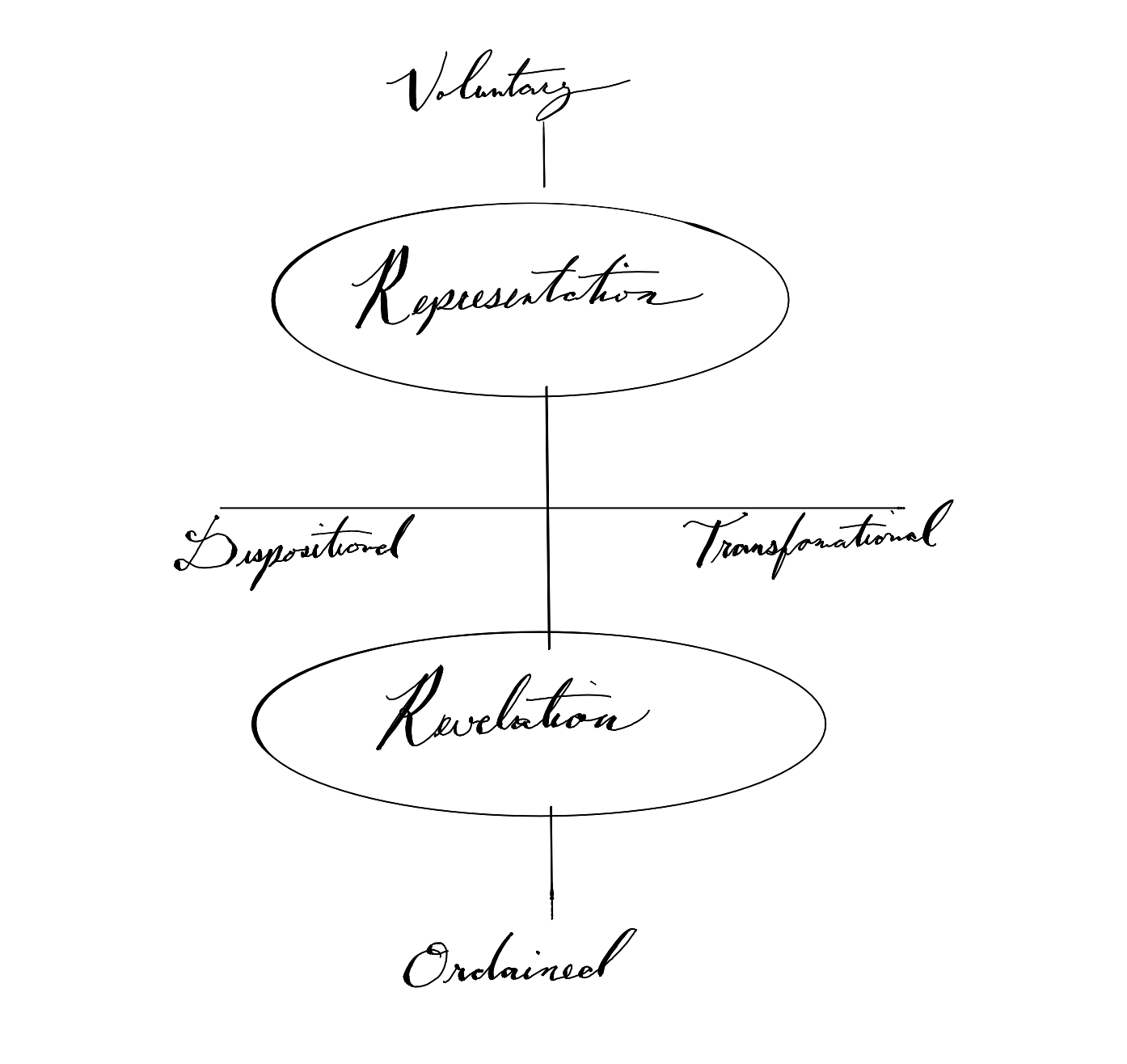
Each of these contains a distinctive relationship of Verification and Veridiction (what justifies action and what behaviors constitute “right action”).
If we use Verification to mean “feedback from exogenous reality and practical consequence”, then we can use Veridiction to refer to the authorization of meaning, legitimacy, and direction within a symbol and communication system. For example, to verify something is to answer the question “Does it work?” To veridicate something is to answer the question “Is it coherent and legitimate?” You need both, but they exist in tension to the extent that symbol systems index a world that’s irreducible to the representation of it. In organizations, the internal struggles of each function bear witness to these tensions being constantly negotiated, and what characterizes a department is the tendency of authority to fall one way or the other.
Representation: In a representation orientation, Veridiction is generally prioritized over Verification. In a Veridiction Priority Regime, what tends to justify action are things like narrative coherence, fidelity to a vision, and legitimacy. Verification plays a supporting role where evidence is used to support an articulated vision. This relationship has distinctive error states: misalignment, false-consciousness, insufficient commitment, ideological deviation, etc.
Revelation: here Verification is prioritized over Veridiction. In the Verification Priority Regime, what tends to justify action are things like pragmatic evidence, effectiveness, external feedback. It’s called revelatory because truth is revealed through action rather than prescribing action. Here veridiction plays a supporting role through the codification of best practices and expertise. It too has distinctive error states: ignoring constraints, unjustified inference, and poor technique, for example.
Important note: these aren’t ontologically exclusive domains, they’re a social diagnostic - veridiction plays a role in what constitutes “works”, verification can inform judgments of legitimacy, but does not by itself authorize meaning or direction. The point is that the asymmetry in a particular regime indicates what’s implicit, what’s unmarked, and what’s authorized. Most importantly, and the reason all regimes aren’t ultimately classified as veridictory, is that this diagnostic reveals relative openness and adaptability to exogenous signals.
Finally, where an org tends to lean impacts what role its output plays and how its output is interpreted relative to its goals and to the subjects of activity.
When I say output here, I’m talking about what an org produces - for example - an artifact, product, northstar vision, strategic goal, etc.
In the upper left quadrant, the one we’ve named Iconic, the representation of an end state serves an Iconic function. The End State is representable as an icon, or image, that represents an end state as appropriately rendered in accordance with a theory of the dispositional subject. It’s a fixed image of the better life as understood through the lens of the dispositionally rendered subject. In today’s political context, you can think of Trad Life, Retvrn, capital-C Conservative, idyllic rendering of a world suited for the subject. Think of Disney’s Celebration community, of Fordlandia (subordinated utopia), or any gated community. In terms of product, you can think of the Ford F-150 or Apple’s AI. The product is an image, or icon, of the good. The operating mode here is Resonance. Corrections and success criteria are structured around achieving resonance between subject and object, and that informs what data are collected, how success is measured, and how specifications are rendered. In terms of validation regime, successful products represent the image of the good and the rendering of the subject. Think Market Fit.
In the upper right, the quadrant we’ve named Utopic, the representation of the end is an ideal, and functions as an Idol. It’s the utopic vision that is intended to pull the plastic subject toward transformation in accordance with a defined ideal. In a political context, this is a space for activism, Progressivism, and emancipation. In terms of product, you should envision ethical AI guidelines, equity metrics, Meta’s Metaverse, Smart Cities, or enterprise AI. The primary operating mode here is Critique, a system or product is judged relative to an ideal end state and corrected accordingly for an idealized subject, independent of the particular subject. This is also a representational regime, where products and subjects are evaluated relative to a fully rendered end state. Think compliance.
Clockwise, in the lower right quadrant called Genic, the representation of the end state is open (to-be-determined), though the subject is plastic. It’s geared toward the transformation of the subject but posits no formal ideal end state. The output and production of this disposition serves as an Impulse, it propels the subject forward toward its potentiality, whatever that may be. Again, in a political context this space is rendered as techno-utopian, Libertarian, Silicon Valley TESCREAL ethos, and transhumanist. Envision here most of Musk’s projects (Mars, neuro-link, xAI). There is notably absent a formal depiction of the good beyond ever more capability and possibility. The good is bracketed. Its primary operating mode is a specific type of revelatory appearance, namely disruption, where new possibilities are revealed through environmental and technical shock rather than through cultivated judgment. Old systems are disrupted and afford new possibilities, the positive end is locating in the opening of worlds, products and services are good to the extent that they function as an impulse enacting change for the sake of disruption. It’s a revelatory validation regime in the sense that exogenous signals are prioritized over veridiction fidelity (there isn’t a represented model to veridicate). Think move fast and break things.
Finally, the lower left quadrant is Praxic. The end state is open ended (to-be-determined, not volunteered) and the subject is dispositional, constrained by history, context, durable and preservation-worthy cultural norms, etc. The output of this orientation is regarded as Index. Products, services, and frameworks index an ordained good but don’t fully represent it. You can think of Jane Jacobs cities, The Shire, small-c conservative projects, regenerative practices, calm technology, or discreet and carefully bounded AI capability like Perplexity. The operating mode here is Luminance, a product or service is good to the extent that it illuminates some aspect of a difficult to represent good. The validation regime here is revelatory in a practice-based sense: through participation, apprenticeship, and refinement, practices disclose standards of excellence and internal goods that cannot be fully specified in advance but nonetheless normatively guide action.
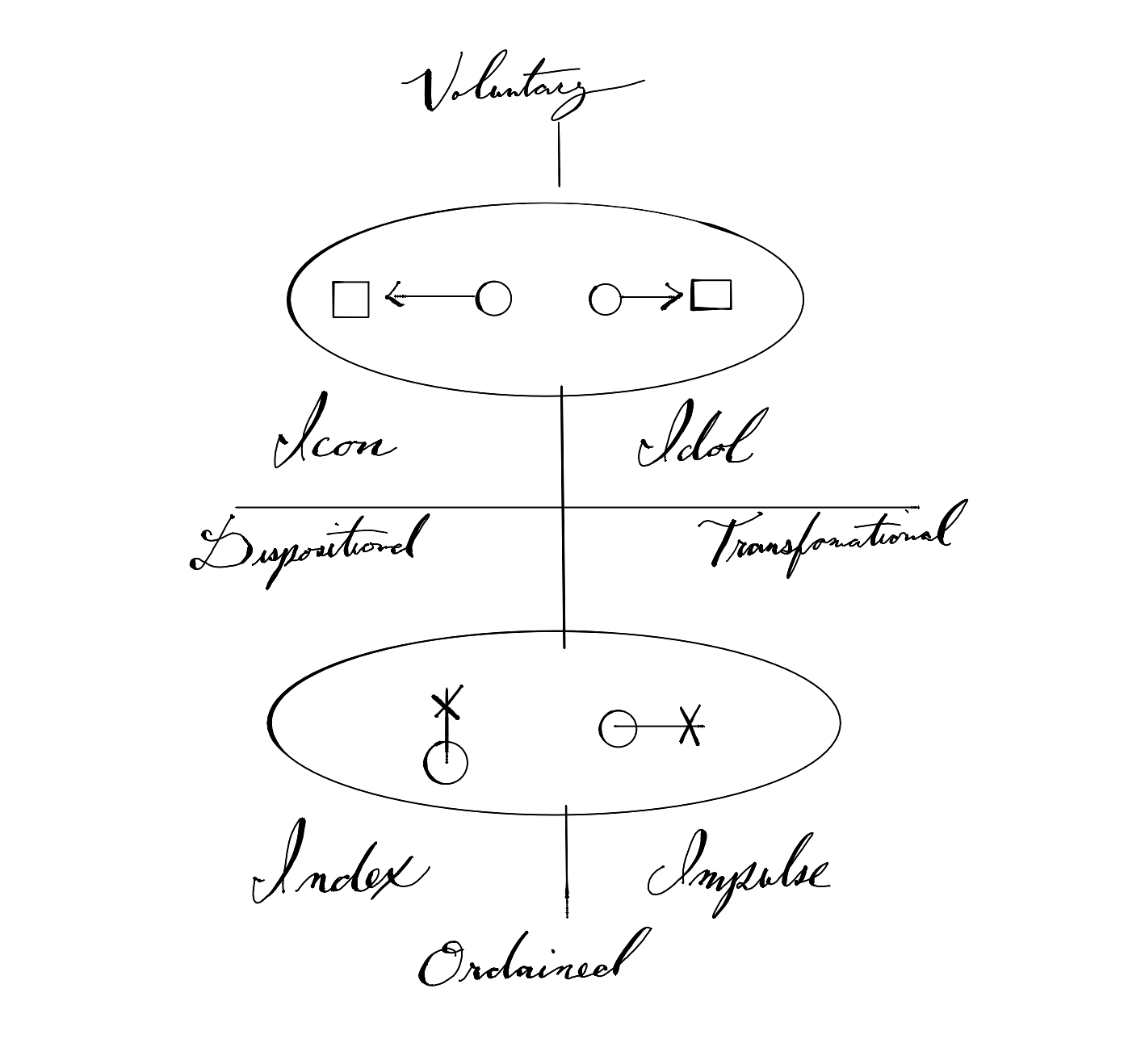
This is the diagnostic I use to assess and align accordance of implicit organizational dispositions, their product and service portfolio, and their development and measurement practices. Almost every problem I’ve seen is describable as a mismatch between these. A Genic regime trying to adopt critical assessments stifles creativity. An Utopic regime trying to build a praxic culture produces disengagement. An Iconic regime attempting to produce impulses but measuring them as icons begets stasis. A praxic regime resonance testing icons frustrates expertise. Of course I have my own preference, but at the very least, aligning your progress hermeneutic to your measurement practices, output, validation regime, and what you call data will help resolve some very typical frictions.
